HLS India logo for business advisory

Articles

UAE Golden Visa Golden Visa categories Golden Visa eligibility UAE

UAE Golden Visa Rumor Debunked – Regulatory Clarification & Client Advisory

Introduction

Recently, various reports have been circulating across media and social platforms suggesting the launch of a new Golden Visa scheme offering lifetime UAE residency for a one-time fee of AED 100,000 (approximately INR 23 lakh). According to these claims, the visa could allegedly be obtained via private nomination through designated third-party agencies, without meeting standard investment or talent-based requirements.

However, following public speculation and rising enquiries, the Federal Authority for Identity, Citizenship, Customs & Port Security (ICP) — the official UAE body overseeing visa and residency matters — has formally denied the existence of such a programme.

This newsletter outlines the nature of the misinformation, clarifies the UAE government’s official position, and provides practical guidance for clients in navigating verified Golden Visa pathways.

 1. What Was Claimed?

The alleged scheme, reported by various non-government news sources and widely shared online, made the following representations:

  • The UAE had opened a nomination-based Golden Visa exclusively for Indian and Bangladeshi nationals.
  • Applicants could secure a lifetime residency visa without business ownership, property investment, or a UAE job offer.
  • The visa would be issued upon payment of a flat AED 100,000 fee (approx. INR 23 lakh), through selected agencies such as Rayad Group and One Vasco.
  • The route required only basic documentation and a clean background check — no need for professional or academic distinction.
  • Nominees would enjoy fast-track processing, family sponsorship rights, and exemption from standard long-term residency criteria.

These claims triggered high interest among investors, professionals, and migration consultants — particularly in India and Bangladesh. For accurate information about legitimate UAE residence visa requirements, applicants should consult official sources.

2. Official Government Clarification

In response to the media coverage, the UAE government — through the ICP — issued an official statement on July 08, 2025, confirming the following:

  • There is no officially approved or active “nomination-based” Golden Visa programme based on a flat-fee model.
  • No private agency or consultancy has been authorized to issue, collect payment for, or directly nominate individuals for Golden Visas on behalf of the UAE government.
  • The only valid Golden Visa categories remain those publicly listed on official UAE portals (including u.ae, icp.gov.ae, and emirate-level immigration authorities).
  • Any updates or additions to visa categories or eligibility criteria are announced formally through Cabinet Resolutions or via the websites of the ICP, GDRFA, or the Office of the Cabinet.

The ICP further cautioned applicants against falling prey to fraudulent promises or unauthorized “express visa” services offered by intermediaries. Professional regulatory compliance guidance ensures adherence to official procedures.

3. What Remains Valid: Golden Visa Categories

The official Golden Visa regime, introduced in 2019 and enhanced in 2022, remains active and accessible via the following recognized categories:

  • Investors in Public Funds/Real Estate Investors: AED 2 million+ property ownership.
  • Entrepreneurs: Founders of start-ups or holders of UAE-registered commercial licences having a project value of more than AED 500,000.
  • Skilled Professionals: Earning basic prescribed monthly salary (around AED 30,000 monthly as of now) in fields such as science, education, law, healthcare, etc.
  • Outstanding Specialized Talents: In fields such as science, engineering, education, culture and arts- like doctors, inventors, artists, executives, athletes, etc.
  • Scientists & Researchers: Recognized by the Emirates Council of Scientists.
  • Outstanding Students & Graduates: From top global and UAE institutions.
  • Frontline Workers & Humanitarians: Those with exceptional service to public health or community impact.

All applications must be filed through official government channels, often with the support of a local sponsor, proof of income, or investment credentials.

How HLS-Global UAE Can Help

As a licensed business advisory and management consultancy firm, HLS-Global UAE assists clients with verified and compliant Golden Visa pathways, including:

  • Eligibility Assessment: We assess individual profiles against official categories to determine the most suitable route.
  • Document Preparation: Our team assists in compiling investment proofs, employment letters, professional certifications, and police-clearance documents.
  • Filing Support: We coordinate applications through GDRFA, ICP, or other government-authorised portals—ensuring accuracy and compliance at every stage.
  • Renewals & Advisory: For existing visa holders, we provide end-to-end support for renewals, family sponsorships, and related legal obligations.
  • Regulatory Monitoring: We stay up to date with Cabinet-level decisions and immigration policy changes to protect our clients from misinformation.
For specialized support, Japanese clients can also access our Japan Desk services.

Connect with us on LinkedIn.

Disclaimer: All views expressed in this article are solely for informational purposes and should not be construed as legal advice. This information is for reference only and is bound to change in case of any amendments or changes to applicable laws. We do not assume any responsibility or liability for any errors or omissions in the content of this article, and we do not make any warranties about the completeness, reliability, and accuracy of the information expressed in this article.

UAE secretarial compliance Corporate governance UAE Cabinet Resolution 102/2022

Secretarial Compliance for Companies in the UAE Enhanced Penalty Regime

Back in November 2022, the UAE dramatically expanded its fines for corporate secretarial lapses under Cabinet Resolution 102/2022, amending Federal Decree-Law 32/2021 (the Commercial Companies Law). What was once mere procedural oversights now carry substantial, per-occurrence fines—up to six figures in dirhams. Both mainland and free-zone companies must now treat minute-taking, register-keeping, and timely filings as mission-critical.

With regulators empowered to suspend licenses, block director appointments, and even dissolve companies for repeat breaches, businesses can no longer afford lapses in basic secretarial duties. This newsletter walks you through the updated obligations, the new fines framework, and how HLS-Global UAE ensures your compliance, penalty-free.

1. Regulatory Framework & Penalty Highlights

Scope & Applicability
  • Mainland Entities under the Commercial Companies Law face the full suite of new fines.
  • Free-zone entities (DIFC, ADGM, DMCC, etc.) enforce similar secretarial rules via local regulations; federal UBO (Ultimate Beneficial Ownership) and certain AML compliance requirements apply across all jurisdictions.
Key Changes in 2022
  • Introduction of fixed fines for secretarial breaches to maintain registers, hold meetings, file resolutions, amend corporate documents, and more.
  • Fines are now per occurrence and escalate on repeat breaches.
  • Regulatory bodies are empowered to suspend licenses, block director appointments, and, in extreme cases, dissolve offending companies. Professional regulatory compliance services help avoid these severe consequences.
Enforcement Authorities
  • Ministry of Economy (MoE): Main overseer for onshore companies.
  • Free-Zone Authorities: DIFC Registrar, ADGM Registration Authority, DMCC Licensing, each with parallel enforcement powers.

2. Core Secretarial Duties & Penalties

Compliance Item

Requirements

Penalty

Corporate      Governance Rules

Ensure compliance with the statutory corporate governance standards

Up to AED 10 million – Public JSC

Change in Trade Name

Ensure compliance with the decision to change the Company’s trade name

AED 500 per month (capped at AED 5,000 yearly)- L.L.C.

AED 1,000 per month (capped at AED 10,000 yearly)- Private JSC

AED 1,000 per month (capped at AED 10,000 yearly)- Public JSC

MoA/Article Amendments

File any change (capital, activity, shareholding) within the statutory deadline

AED 1,000/month (capped AED 10,000/year)- L.L.C.

AED 1,500/month (capped AED 15,000/year)- Private JSC

AED 2,000/month (capped AED 20,000/year)- Public JSC

Convene the General Assembly when losses ≥50% of capital

Within 4 months of financial year-end; keep minutes on file

AED 50,000- L.L.C.

AED 100,000- Private JSC

AED 200,000- Public JSC

Share Certificates

Ensure compliance with the rules on issuing, endorsing, or safeguarding physical share certificates.

AED 200,000- Public JSC

Auditor Appointment

Ensure the appointment of an auditor duly licensed by the MoE/Authority.

AED 50,000- Private JSC

AED 200,000- Public JSC

Inspection Cooperation

Provide access to premises, records, and systems on request

AED 5,000- L.L.C.

AED 10,000- Private JSC

AED 200,000- Public JSC

Financial Year Accounts

Prepare and present the year-end accounts for board/shareholder approval

AED 50,000- Private JSC

AED 100,000- Public JSC

Accounting & Records

Keep   financial  books & records at the registered office

AED 15,000- L.L.C.

AED 20,000- Private JSC

AED 100,000- Public JSC

Access to Books/Minutes

Provide the partners/shareholders access to the minutes of the General Assembly, books, etc.

AED 5,000 – L.L.C.

AED 10,000- Private JSC

AED 100,000- Public JSC

Board Meeting Invitation to Director

Chairman/Director to send invitation to the Director(s)/Manager(s)  for Board Meeting

AED 3,000- L.L.C.

AED 8,000- Private JSC

AED 100,000- Public JSC

Registration Process

Ensure the undertaking registration process is completed within 10 (ten) working days from the issuance of the certificate of incorporation

AED 20,000- Private JSC

AED 100,000- Public JSC

Board Formation

Formation of the Board Quorum as per the statutory requirements

AED 10,000- Private JSC

AED 200,000- Public JSC

Board Vacancy & Nomination

Comply with the prescribed procedures in case of vacancy/nomination to the Board

AED 10,000- Private JSC

AED 200,000- Public JSC

Annual General Assembly

Within 4 months of financial year-end; keep minutes on file

AED 5,000 (up to AED 10,000 if regulator-ordered)- L.L.C.

AED 30,000 (up to AED 50,000 if regulator-ordered)- Private JSC

AED 200,000 (up to AED 200,000 if regulator- ordered)- Private JSC

Unauthorized Share Transfers

Process or record transfers outside legal procedures

AED 20,000- L.L.C.

AED 50,000- Private JSC

AED 200,000- Public JSC

Statutory Registers (Shareholders/Directors)

Maintain and update continuously

AED 100,000- Public JSC

UBO Register

Record & updates the Ultimate Beneficial Owners upon any change

AED 20,000 (2nd offence)

AED 40,000 (3rd offence)

Board Meetings

At least 4 per year; written notice & signed minutes

AED 3,000- L.L.C.

AED 8,000- Private JSC

AED 100,000- Public JSC

Note: Repeat offenses trigger double or triple penalties and may lead to license suspension or director disqualification.

3. Compliance Process & Critical Timelines

To stay ahead of penalties, companies should adopt a disciplined secretarial workflow:

Centralized Registers & UBO Tracking
  • Use a digital register system to record all shareholder, director, and UBO changes instantly.
  • Review and reconcile registers monthly to ensure accuracy.
Meeting Management
  • Schedule board meetings quarterly and the Annual General Assembly within four months of year-end.
  • Issue formal notices 7–14 days in advance; circulate agendas and draft minutes promptly.
Document Filing Cadence
  • File the MoA amendments within 30 days of any capital or shareholding change.
  • Submit license renewal applications and corporate registry updates at least 30 days before expiry. New businesses should understand these requirements during UAE business setup to ensure smooth operations.
  • Notify regulators of director or shareholder changes within 30 days.
Record Retention & Inspection Readiness
  • Maintain accounting records and board/shareholder minutes on-site for five years.
  • Conduct quarterly internal audits of secretarial files to verify compliance.
Ongoing Monitoring
  • Subscribe to regulatory alerts for changes in Cabinet resolutions or the free zone rules.
  • Perform an annual “secretarial health check” to identify gaps and remediate them before year-end.

How HLS Global UAE Streamlines Your Compliance

HLS Global UAE’s corporate secretarial practice offers end-to-end support to keep you penalty-free:

► Compliance Health-Check: A rapid 360° audit of your registers, minutes, filings, and policies to spot gaps.

► Document Preparation: Draft and file board resolutions, notices, MoA amendments, and UBO disclosures on your behalf.

Regulator Liaison: We handle all dealings with MoE, free-zone authorities, and UAE financial intelligence units to ensure timely approvals.

► Ongoing Monitoring & Alerts: Automated calendar reminders for meetings, renewals, and filing deadlines so nothing slips through.

► Training & Governance: Workshops for your directors and company secretaries on best practices and new regulatory trends.

“Our proactive approach transforms secretarial compliance from a reactive chore into a seamless, audit-ready process—eliminating fines and freeing you to focus on growth.”

Partner with HLSGlobal UAE to safeguard your business against the UAE’s enhanced secretarial penalties.

📧 info@hls-global.ae  |   🌐 www.hls-global.ae

Disclaimer: All views expressed in this article are solely for informational purposes and should not be construed as legal advice. This information is for reference only and is bound to change in case of any amendments or changes to applicable laws. We do not assume any responsibility or liability for any errors or omissions in the content of this article and do not make any warranties about the completeness, reliability, or accuracy of the information expressed in this article.


UAE Virtual Asset Licensing Guide for VASPs | HLS Global

Navigating the UAE’s Virtual Asset Licensing Landscape A Strategic Guide for VASPs

As the United Arab Emirates cements its position as a global crypto hub, Virtual Asset Service Providers (VASPs) eyeing expansion into this dynamic region must understand the regulatory landscape. With multiple regulatory bodies across federal and free zone jurisdictions, getting licensed in the UAE requires a tailored, jurisdiction-specific strategy. At HLS Global UAE, we specialize in simplifying this process end-to-end.

Understanding the UAE’s Regulatory Structure for VASPs

The UAE’s approach to virtual asset regulation is multi-tiered and jurisdiction-specific.

Regulator

Jurisdiction

Role

SCA – Securities and Commodities Authority

Onshore            UAE (Mainland)

Federal oversight of VASPs and digital asset issuance

VARA – Virtual Assets Regulatory Authority

Dubai       (excluding DIFC)

World’s first dedicated VA

regulator

DFSA – Dubai Financial Services Authority

DIFC              (Dubai International Financial Centre)

Independent        regulator under common law

FSRA     –     Financial     Services Regulatory Authority

ADGM   (Abu   Dhabi Global Market)

Robust, mature virtual asset framework

RAKEZ – Ras Al Khaimah Economic Zone

RAKDAO     (Ras    Al

Khaimah        Digital Assets Oasis)

Exclusively   dedicated   to virtual assets

Key Licensing Requirements for VASPs

Across jurisdictions, the licensing requirements typically include:

General Requirements:
  • Corporate structure: UAE legal presence (LLC, branch)
  • Fit & proper management: Background, financial soundness, and experience
  • Capital adequacy: Varies by business model (custody, exchange, broker)
  • Technology & Cybersecurity: Robust infrastructure & AML (Anti-Money Laundering) systems, STR/SAR reporting, KYC policies, ongoing monitoring, and independent audit trails
Specifics by Regulator:
  1. SCA (Mainland UAE)
    • License categories: Brokerage, Custody, Exchange, Platform Operator
    • Capital Requirement: AED 100,000–1 million plus
    • License Process: Pre-application consultation with the SCA, followed by review phas,e and final grant of license
    • Application fee: AED 55,000–500,000 plus (depending on category)
    • Requires local bank guarantee & insurance in some cases
  2. VARA (Dubai)
  • Regulates across 8 activity types (exchange, broker-dealer, custodian) in Dubai World Trade Centre (DWTC) and other non-DIFC Dubai jurisdictions
  • 2-step license process: Initial Approval to Incorporate (ATI) to finalize the firm’s legal incorporation and operational setup, followed by the issuance of a full VASP License
  • Capital Requirement: AED 100,000-1,500,000
  • Application Fees: AED 40,000-100,000 per VA activity; Annual Supervision Fee: AED 80,000-200,000
  • Strict reporting, VA risk framework on AML/CFT, and board governance rules

3. DFSA (DIFC)

  • License under the Investment Token and Crypto Token Regime
  • Risk-based prudential requirements, technology architecture, plus the VA business plan are essential
  • License Process: Authorization Enquiry to be submitted on the DFSA portal, and according to approval thereof, the final application needs to be submitted along with the requisite fee on the portal; Crypto Token recognition request to be submitted separately on the portal
  • Application Fee: USD 15,000-70,000 (depending on the activity); Additional Fee: USD 5,000 (for Crypto Token Recognition)
4.   FSRA (ADGM)
  • Regulatory framework recognizes certain virtual assets, including cryptocurrency
  • VASP Full License: Permits exchange, broker-dealer, custody, and token issuance; Limited Activity License: For targeted services, such as custody-only or ICO
  • Capital: Risk-based (minimum USD 250,000 for VASP custodians)
  • License Process: Engagement with FSRA for feedback on business model, followed by submission along with the requisite corporate documents, and finally the grant of license post-review by FSRA (within 3-4 months typically)
  • Application fee: USD 20,000–40,000; Annual Supervision: USD 15,000–50,000
5. RAKEZ (RAK DAO)
  • Overseen by the RAKEZ, which requires applicants to submit a detailed business plan, a comprehensive AML/CFT framework, and fit-and-proper declarations for senior management
  • Two-step license process – Application with the SCA, which entails pre-approval followed by full licensing – typically completed in 6–8
  • Application Fee: USD 4,500-9,500 plus applicable SCA license fee for VASP

Licensing Process Snapshot (Generic Flow)

  • Business Scoping & Legal Structure Setup
  • Engagement with Regulator (Expression of Interest / Consultation)
  • Submission of VASP License Application
  • Review, Interviews, & Clarifications
  • License Issuance + Go Live Approvals

Timeline: 3 to 9 months, depending on jurisdiction and business complexity.

How HLS Global UAE Helps You Get Licensed – Seamlessly

At HLS-Global UAE, we specialize in end-to-end regulatory licensing and compliance advisory for VASPs. Here’s how we deliver value:

Jurisdiction Mapping: We evaluate your model and identify the most suitable UAE zone and regulator (SCA, VARA, DIFC, ADGM, or RKDAO).

End-to-End Licensing Support: From documentation to regulatory liaison, submission tracking, and handling pre-consultation rounds.

License Documentation: From AML frameworks, business plans, to regulatory compliance – we build compliant and regulator-ready documents.

Post-Licensing Compliance: Ongoing support for transaction monitoring and regulatory updates.

Final Word

The UAE offers a fertile regulatory environment for compliant, growth-focused VASPs. But the complexity lies in picking the right zone and aligning with evolving compliance obligations. With deep legal and regulatory expertise, HLS-Global UAE ensures your crypto venture launches seamlessly – with speed, accuracy, and trust.

Disclaimer: All views expressed in this article are solely for informational purposes and should not be construed as legal advice. This information is for reference only and is bound to change in case of any amendments or changes to applicable laws. We do not assume any responsibility or liability for any errors or omissions in the content of this article, and we do not make any warranties about the completeness, reliability, or accuracy of the information expressed in this article.

uae crypto regilations

Crypto Market Regulation: Global & UAE Overview

Welcome to the first installment of our crypto regulation newsletter series. Over the coming editions, we’ll dive into specifics — licensing, governance, compliance, and more — focusing primarily on the UAE. In this brief kickoff, we’ll sketch out the global regulatory environment and then zoom in on how the United Arab Emirates is approaching digitalasset oversight. Think of this as your crash course on “why regulation matters” and “how things look today,” before we unpack the details in future issues.

🌍Global Snapshot: A Broad-Brush Overview

Global cryptocurrency regulation remains highly fragmented, reflecting diverse national priorities ranging from fostering innovation to ensuring financial stability. While some jurisdictions like the United States, the UK, the European Union, and Japan, have recognized and introduced comprehensive licensing and taxation frameworks on virtual digital assets, including cryptocurrency, others, such as China, have maintained a blanket ban on all cryptocurrency trading and mining operations. In the context of India, the cryptocurrency framework is not yet regulated and is still evolving, with the cryptocurrencies being recognized as “virtual digital assets” and subject to taxation, whose capital gains are taxable at a flat 30% whereas TDS is deducted at 1% of sale consideration. Similarly, across other markets—South Korea, Brazil, South Africa, and the UAE—authorities have introduced licensing regimes obligating the virtual assets service providers (VASPs) to register, impose AML/KYC safeguards, and report large transactions on an ongoing basis, aligning with broader UAE crypto regulations.

Thus, across major economies, regulators have been taking steps towards balancing consumer protection, adherence to anti–money laundering (AML) and combating the financing of terrorism (CFT) protocols, and market integrity against the perceived benefits of digital-asset adoption.

United Arab Emirates: Building a Crypto Hub

The UAE’s approach to cryptocurrency regulation has evolved into a multi-layered framework that balances innovation with robust oversight. At the federal level, the Central Bank of the UAE (CBUAE) introduced the Payment Token Services Regulation in early 2025, explicitly defining “payment tokens” (including stablecoins) and requiring licensure for issuance, conversion, custody, and transfer activities within the UAE. Simultaneously, the Securities and Commodities Authority (SCA) maintains federal oversight of certain virtual asset classifications and collaborates with free-zone regulators to ensure consistency— most prominently Dubai’s Virtual Assets Regulatory Authority (VARA) and Abu Dhabi’s ADGM (Abu Dhabi Global Market).

All virtual asset service providers (VASPs) must be licensed either by the SCA (for onshore/UAE-wide activities) or by VARA (for Dubai, including free zones under DWTC); Dubai‐licensed VASPs are automatically registered with SCA, whereas providers outside Dubai must directly secure SCA approval. In ADGM, the Financial Services Regulatory Authority (FSRA) has governed VASPs since 2018, having broadened its mandate to address NFTs, DeFi, and decentralized autonomous organizations (DAOs) in the line with uae crypto regulations.

In Dubai, the VARA was established under Law No. (4) of 2022—it oversees all virtual asset activities outside the Dubai International Financial Centre (DIFC) and operates tailored rulebooks for custodial staking and issuances, thereby bolstering investor protections and market integrity under evolving uae crypto regulations. Meanwhile, the Dubai Financial Services Authority (DFSA) enforces its regulatory regime within the DIFC, encompassing security token offerings, custody services, and updated AML/CFT requirements. Accordingly, all VASPs intending to operate within the DIFC must obtain a license to conduct financial services in relation to crypto tokens, whereas existing authorized firms must apply for a variation to include these activities.

Within the UAE, all VASPs are subject to stringent AML Laws, requiring comprehensive AML/CFT policies, KYC procedures, transaction monitoring, and sanctions screening. Marketing and promotional materials need pre-approval, must be clear, accurate, non-misleading, and include prominent risk disclosures. Enforcement is backed by the cybercrime law in the UAE, which criminalizes unlicensed crypto trading and related fraud.

Through these concerted efforts, the UAE has emerged as a global leader in virtual asset regulation. ADGM was among the first jurisdictions worldwide to codify a comprehensive VASP framework in 2018, while VARA’s rapid updates in early 2025—particularly its fiat-referenced asset rules and streamlined licensing (including default SCA registration)— position Dubai at the forefront of regulatory best practices. Moreover, the introduction of the RAK Digital Assets Oasis in February 2025, the world’s first free zone dedicated exclusively to virtual asset enterprises, underscores the UAE’s commitment to fostering a supportive ecosystem for cryptocurrencies and demonstrates how its regulatory vision not only aligns with international norms but also actively shapes them.

💡Key Takeaways

🌐Global Regulatory Regime

As of mid-2025, the global regulatory regime for cryptocurrencies oscillates between permissive innovation hubs (e.g., Japan, EU, USA) and stringent prohibitions (e.g., China).

Major economies emphasize AML/KYC, consumer protection, and tax transparency, while grappling with how to balance innovation and systemic risk. With India expected to formalize its approach imminently, and other nations refining licensing or tax frameworks, the regulatory environment will likely converge on core principles—licensing, transparency, consumer safeguards, and AML—while allowing differentiated market-access models aligned with each jurisdiction’s strategic priorities.

UAE’s Multi-Pronged Approach

At the federal level, the SCA has set broad definitions and AML rules. In parallel, free zones like ADGM, DIFC, and now VARA in Dubai have fashioned more detailed, innovation-friendly rules that aim to attract global crypto businesses under the evolving uae crypto regulations. Investors and traders need to know which platforms are properly licensed (federal SCA vs. free-zone regulator) to feel confident that their assets are safeguarded. Startups & Token Issuers must decide where to incorporate—ADGM, DIFC, or under VARA in Dubai—based on capital requirements and local presence. Accordingly, the legal & compliance teams will need to map out licensing checklists, AML/CFT workflows, and ongoing reporting requirements before launching any crypto venture in the region.

Connect with us on LinkedIn.

Disclaimer: All views expressed in this article are solely for informational purposes and should not be construed as legal advice. This information is for reference only and is bound to change in case of any amendments or changes to applicable laws. We do not assume any responsibility or liability for any errors or omissions in the content of this article, and we do not make any warranties about the completeness, reliability, and accuracy of the information expressed in this article.

risk assessment in contract management

How to Navigate Contract Risks in the UAE: Essential Tips for CEOs and CFOs in 2025

Introduction

In the UAE, contracts don’t fail in court—they fail in execution. A poorly structured agreement can cause business deadlock, risk your trade license, or trigger regulatory audits. In 2025, regulatory scrutiny is sharper than ever. The Ministry of Economy, the FTA, and banks now flag contracts that lack clarity around ownership, control, and compliance—making risk assessment in contract management more critical than ever.

CEOs and CFOs must treat risk assessment in contract management as a business-critical step, not a legal formality. It starts well before signing.

At HLS-Global UAE, we guide clients through contract drafting by first examining operational fit. We examine commercial terms that banks will scrutinize, dispute forums that courts will enforce, and governance structures that regulators expect.

Contracts must work in practice, not just on paper. That’s why we align legal language with licensing, AML, and UBO compliance, so you stay bankable, scalable, and protected while doing business in the UAE.

Hidden Risks CEOs and CFOs Miss When Drafting UAE Contracts

Payment terms that don’t match the company’s VAT treatment can trigger tax audits or block recoverable input VAT. Worse, unclear fund flows or beneficiary details can raise AML flags, delaying banking transactions or even freezing accounts. These are not legal hypotheticals—they’re operational disruptions.

Jurisdiction clauses are another blind spot. Without precise language, disputes end up in the wrong forum, costly and unenforceable. Vague POA or management roles often result in shareholder deadlock. And when partners operate under mismatched licenses—say, one mainland, one free zone—the entire deal may be non-compliant. Smart contract drafting backed by real risk assessment in contract management prevents these issues before they surface. HLS-Global UAE structures contracts that hold up in audits, banks, and boardrooms.

Risk Assessment in Contract Management: Key Pre-Signing Filters

  • Before you sign, stress-test your contract like you would a financial model.
  • CEOs and CFOs must conduct risk assessment in contract management with a local enforcement lens, not just legal theory. Start with enforceability: Is the dispute forum practical? DIFC, ADGM, and onshore UAE courts each have distinct recognition and appeal limits.
  • Contract drafting must define who controls payments and where capital moves. Vague language here triggers red flags under the UAE’s AML regime and can stall account approvals.
  • Check alignment with Ultimate Beneficial Ownership (UBO) disclosure, and VAT obligations—non-compliance will compromise your audit trail and tax position.
  • Finally, plan for failure: If the deal goes south, what’s your path to recover funds or enforce terms inside the UAE?
  • At HLS-Global UAE, we decode these risks before contracts are finalized, so execution doesn’t unravel under regulatory or operational pressure.

UAE-Specific Clauses That Need Rethinking in 2025

  • Contract drafting in the UAE demands sharper precision in 2025.
  • Force majeure clauses must now reflect actual risk, not vague disruptions. Courts are stricter, especially post-COVID.
  • Choosing a dispute forum—DIFC, ADGM, or onshore—should align with enforceability, cost, and deal structure.
  • Most overlooked: AML clauses. Banks increasingly review B2B contracts for onboarding steps, UBO clarity, and control rights.
  • Effective risk assessment in contract management now includes mapping regulatory exposure and drafting accordingly.
  • HLS-Global UAE ensures your contracts match current enforcement trends, not outdated templates.

How HLS-Global UAE Fixes Contracts Before They Break?

At HLS-Global UAE, we don’t just review contracts—we design them around operational and regulatory logic.

Instead of waiting for disputes or compliance failures, we embed risk assessment in contract management from day one.
 Our team works across functions—finance, tax, legal, and compliance—to ensure each contract is structurally sound and practically enforceable.

We map out:

  • Regulatory triggers like AML, UBO, and VAT that affect payment flows and partner obligations
  • Escalation paths that offer commercial dispute resolution before costly litigation
  • Banking and licensing alignment so contracts don’t get blocked by enforcement trends or account scrutiny

When we assist with contract drafting, we treat it as a business continuity tool, not just a legal formality.
 We build contracts that banks can work with, regulators can understand, and businesses can execute.

That’s how we help clients avoid breakdowns—before they happen.

Final Word: Contract Management Is Now a Business Continuity Function

In 2025, contracts are more than legal documents—they’re critical to your business continuity. CEOs and CFOs must treat risk assessment in contract management like reviewing a financial model. This means applying stress tests, maintaining version control, and ensuring full compliance visibility at every stage.

A single ambiguous clause can trigger operational disruptions—frozen accounts, licensing delays, or vendor refusals—costs that hit your bottom line hard. These are not theoretical risks; they translate into real business interruptions.

HLS-Global UAE advises embedding compliance checks for AML, UBO, and VAT right into the contract drafting process. This proactive approach aligns legal language with operational realities and banking expectations.

Make contract drafting a strategic priority. Partner with HLS-Global UAE to build resilient contracts that protect your business, support regulatory compliance, and reduce friction in doing business in UAE. Don’t wait for a crisis to manage your contract risks.

Connect with us on LinkedIn.

Disclaimer:_ All views expressed in this article are solely for informational purposes and should not be construed as legal advice. This information is for reference only and is bound to change in case of any amendments or changes to applicable laws. We do not assume any responsibility or liability for any errors or omissions in the content of this article, and do not make any warranties about the completeness, reliability and accuracy of the information expressed in this article._

business setup services uae

Business Setup Services UAE: How Much Does It Cost to Start a Business Beyond the Trade License?

Introduction

Most new UAE investors focus on one number—the trade license fee. But that’s just the beginning.

In reality, the license covers only 30–40% of your actual business setup costs. The rest depends on:

  • Your legal structure (LLC, branch, or free zone entity)
  • Type of business activity (especially if it’s regulated)
  • Compliance requirements (AML, UBO, VAT and CT registration)
  • Your chosen jurisdiction—Mainland, DIFC, DMCC, or others, and whether you engage professional business setup services UAE.

If you’re serious about doing business in Dubai, you need a full cost and compliance picture, not just a quick agent quote.

At HLS-Global UAE, we act as advisors first. We don’t just register entities—we design them to support long-term operations, banking access, and regulatory readiness. Our clients get real numbers, clear guidance, and a structure that works from day one. Before you license, get the full view. We’ll help you plan it right.

Direct Costs: License, Approvals, and Visas

If you’re serious about doing business in Dubai, budgeting for direct setup costs isn’t optional; it’s strategic. Start with your trade license. Mainland licenses from Dubai’s DED come with different fees and scope compared to free zones like DMCC or IFZA. Choosing wrong can lock you out of key activities or inflate renewal costs.

Initial approvals vary, too. The Department of Economic Development (DED), the Ministry of Economy, and the Municipality each have distinct clearance timelines and fees, especially for regulated sectors. Then comes your immigration card and visa quotas. These depend on office size and license type. Misjudging this can block employee onboarding or raise future expansion costs. Office space is another non-negotiable. Many licenses require a physical lease, not just a flexi desk, to issue visas or open bank accounts.

Finally, don’t overlook banking setup charges. UAE banks demand high minimum balances and apply monthly fees aggressively. HLS-Global UAE helps you model these upfront, so you stay compliant and cost-efficient from day one.

Hidden Costs Most Firms Don’t Tell You

Many new investors focus only on license fees and office rent. But the true cost of setting up a joint venture goes much deeper, and most firms won’t flag these upfront.

At HLS-Global UAE, we help clients budget for the real-world costs that affect both compliance and operations:

  • UBO and AML documentation: Required for every UAE entity. Missing or incomplete Anti-money Laundering records can delay bank onboarding or trigger account reviews.
  • Legal translation and notarization: All documents submitted to UAE authorities must be in Arabic and notarized locally—an often overlooked cost.
  • PRO and government liaison fees: Licensing, visa processing, and regulatory renewals require ongoing PRO engagement.
  • Insurance obligations: From health insurance to WPS-compliant payroll cover—these are not optional.

We prepare you for all of it—no surprises, no gaps, just clarity.

Compliance and Structuring: Where Poor Planning Gets Expensive

In Dubai, compliance missteps cost more than just time—they can shut down your venture. Choose the wrong license activity, and you risk application rejections or regulatory fines. Use a poor shareholding structure, and you face tax inefficiencies or account restrictions. Neglecting AML or UBO filings can delay your setup—or worse, freeze operations post-launch. The right business setup services UAE can help avoid these pitfalls.

At HLS-Global UAE, we reverse-engineer your proposed venture from commercial goals. Our approach to doing business in Dubai integrates AML compliance, license strategy, and tax planning—so your structure supports growth, not triggers risk.

Cost by Type of Setup (With Sample Ranges)

When doing business in Dubai, startup costs vary widely based on structure, license activity, and visa needs.

Here’s a general range:

  • Sole Establishment: AED 15,000–25,000
  • Free Zone FZCO: AED 20,000–40,000
  • Mainland LLC (2+ visas): AED 35,000–60,000

These estimates cover licensing, registration, and basic visa support. But actual costs depend on factors like regulatory approvals, office space, and required third-party NOCs.

Our advisors provide tailored cost breakdowns after reviewing your business model, ensuring you’re set up-ready from day one, with no surprises.

How HLS-Global UAE Helps Clients Control Setup Costs?

Setting up a JV or new entity in the UAE often leads to cost overruns—not because the market is expensive, but because businesses start without clarity.

At HLS-Global UAE, we take an advisory-first approach. Before you spend, we map your setup path:

  • Entity type based on your exact business activity
  • Visa and quota needs tied to real staffing plans
  • Licensing options based on location, control, and compliance risk

Each setup plan is tailored to your business goals, banking needs, and compliance requirements.

We guide you through:

  • Pre-approval banking coordination
  • UBO disclosures and AML compliance
  • Government fee forecasting

When you’re doing business in Dubai, controlling setup costs starts with avoiding wrong moves. We make your first dirham count—because we design the setup around your operation, not around a brochure.

Final Word: Budget for Setting Up the Right Way

When you’re doing business in Dubai, don’t just opt for the cheapest trade license available. Think like a founder, building for scale, compliance, and banking trust. A low-cost setup may seem attractive upfront, but it often leads to misaligned structures, frozen accounts, and costly reconfigurations down the road—especially if done without proper business setup services UAE.

At HLS-Global UAE, we advise thorough due diligence.
 Consider these factors:

  • Robust licensing framework aligned with UBO and AML compliance
  • A scalable structure that appeals to banks and partners
  • Initial costs that protect your venture against unforeseen regulatory setbacks

Investing in a proper setup is not about immediate savings—it’s about protecting long-term growth and operational resilience.
 Securing the right infrastructure from the start builds confidence among banks, investors, and regulators.
Talk to HLS-Global UAE for real clarity on setup costs and strategic next steps to ensure your venture is built for success in the UAE market.

Connect with us on LinkedIn.

Disclaimer:_ All views expressed in this article are solely for informational purposes and should not be construed as legal advice. This information is for reference only and is bound to change in case of any amendments or changes to applicable laws. We do not assume any responsibility or liability for any errors or omissions in the content of this article, and do not make any warranties about the completeness, reliability, and accuracy of the information expressed in this article._

HLS Blog Banner (2)

Doing Business in the UAE

UNITED ARAB EMIRATES – A BRIEF BACKGROUND

hls dbiu

UAE GDP :
USD 525 Billion (Approx)

UAE Population :
9.50 Million Approx.
(15% Local; 85% Expats)

UAE FDI :
USD 30.68 Billion (Ranked first
in FDI inflows in MENA Region)

Total Land Area : 71,023.6
square km (in addition 27,624.9
square km of territorial water).

dobhls

Official Language: Arabic
Business Language: English
Government correspondence is mainly conducted in Arabic.

The UAE is an Islamic Nation, and the legal system is largely based on Islamic teachings.

WHY UAE?

hlsdb
HLSDBA
hls

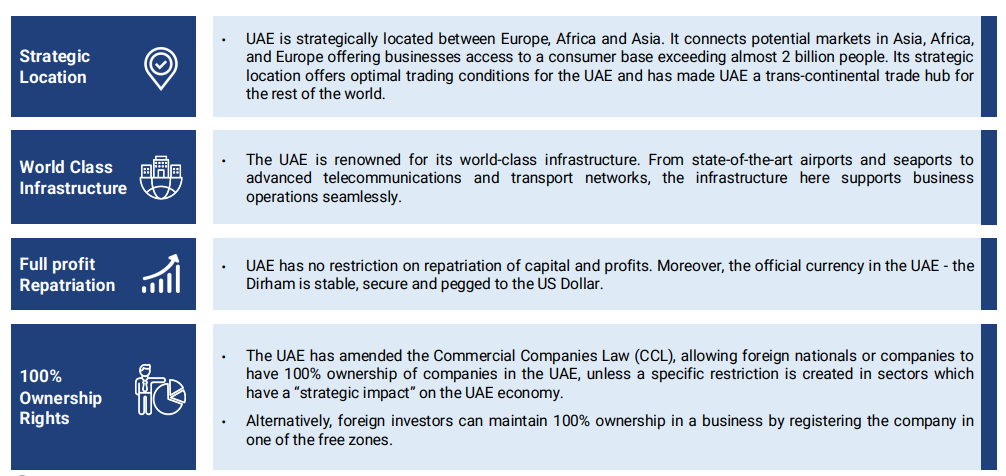
Strategic Location

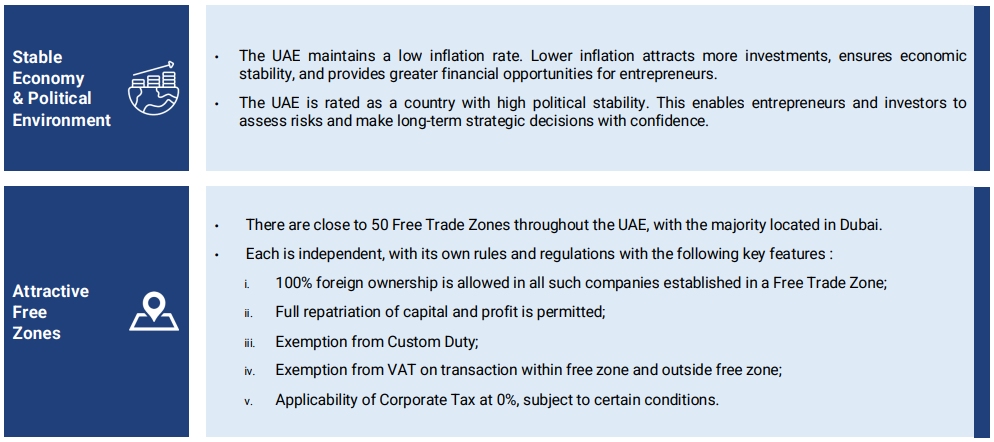
UAE is strategically located between Europe, Africa and Asia. It connects potential markets in Asia, Africa, and Europe offering businesses access to a consumer base exceeding almost 2 billion people. Its strategic location offers optimal trading conditions for the UAE and has made UAE a trans-continental trade hub for   the rest of the world.

World Class Infrastructure

The UAE is renowned for its world-class infrastructure. From state-of-the-art airports and seaports to advanced telecommunications and transport networks,  the infrastructure here supports business operations seamlessly.

OPTIONS FOR DOING BUSINESS IN THE UAE
OPTIONS-1
icon Without setting up legal entity in the UAE

  • Directly with UAE customers/clients; or
  • Via a UAE agent or distributor.
OPTIONS-2
icon Execution of Projects in the UAE
  • Fly-in fly-out (to the extent a local license is not required); or
  • Via a sub-contractor; or
  • Unincorporated joint venture (with a local or foreign partner).
OPTIONS-3
icon With legal setup in the UAE
  • There are two main options available to a foreign investor to set up an entity in UAE:
    1. set up in ‘onshore’ UAE (Mainland) to undertake business within that emirate and outside the UAE; and
    2. set up in one of the Free Zones in the UAE to undertake business within the free zone and outside the UAE.
  • Note: It is also possible to set up a business presence as an offshore company in Jebel Ali Free Zone (JAFZA) and Ras Al Khaimah International Corporate Centre (RAK ICC). These offshore companies are not permitted to carry out business in the UAE.
  • The process for establishing a legal entity in the UAE depends on:
    1. jurisdiction in which the company is proposed to be established i.e mainland or free zones;
    2. type of the legal entity; and
    3. nature of its activities.
PROCESS FOR SETTING UP LEGAL ENTITY IN UAE
1

Application

Submitting an application for Initial Approval

2

Reservation

Reservation of a Trade Name

3

Leasing

Arrangement of Lease Agreement (Ejari) for office

4

Documentation

Submission of the required documents, duly attested, mainly:

  • Promoter’s constitutional documents e.g. Certificate of Incorporation, MOA/AOA, Shareholding Pattern;
  • Resolution from Promoter Company for incorporation of the Company;
  • Resolution for the appointment of Manager;
  • Ultimate Beneficial Ownership (UBO) Declaration
5

Registration

Upon the issuance of license, subsequent registration with the Labour Department and Immigration

6

Onboarding

Submission of works contract for the manager and VISA processing

Note: Once Emirates ID is obtained, bank account opening process to be initiated. Banks in the UAE carry out thorough due diligence process due to stringent AML guidelines prevailing in the UAE.
RECOMMENDED ACTION
UAE carries unparalleled business opportunities however due to availability of multiple options and heavy jurisdictional segmentation, it is highly recommended to have a detailed market entry strategy taking into account:
The proposed business model, products and/or services to be supplied;
The nature and location of target customers and suppliers;
Availability of appropriate licensed activities;
Availability of required infrastructure to cater the proposed business model
The office and employee arrangements.

Disclaimer: All views expressed in this article are solely for informational purposes and should not be construed as legal advice. This information is for reference only and is bound to change in case of any amendments or changes to applicable laws. We do not assume any responsibility or liability for any errors or omissions in the content of this article, and do not make any warranties about the completeness, reliability and accuracy of the information expressed in this article.

Dubai Market Entry, market entry

Dubai Market Entry: Regulatory Triggers Foreign Investors Can’t Afford to Miss

The UAE remains a magnet for international investors due to its strategic location, robust infrastructure, and business-friendly environment. However, understanding and complying with the regulatory framework is crucial for foreign investors and multinational companies considering entry into the UAE market. The UAE’s evolving legal and tax landscape demands meticulous planning, especially regarding company formation and doing business in Dubai or any of the other Emirates. Navigating Dubai market entry requires a clear understanding of these regional distinctions.

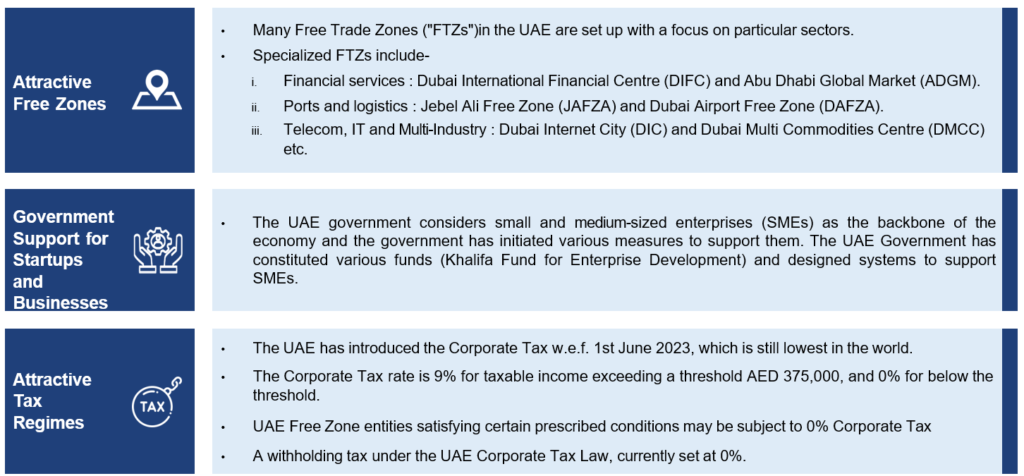
One of the first regulatory decisions investors face is selecting the appropriate jurisdiction: mainland, free zone, or offshore. Mainland businesses, licensed by the Department of Economic Development (DED), can trade anywhere in the UAE and participate in government tenders. Free zones such as DMCC, DIFC, or ADGM offer 100% foreign ownership and sector-specific advantages but limit commercial activity within the UAE mainland unless local agents are used. Offshore structures, regulated by jurisdictions like JAFZA Offshore or RAK ICC, are designed for holding assets or international trade, not local operations.

A major trigger for businesses entering the UAE is the introduction of Corporate Tax in 2023. A 9% tax now applies to profits exceeding AED 375,000, making it essential for foreign companies to plan tax structures carefully. Furthermore, VAT compliance becomes mandatory if annual turnover surpasses AED 375,000, requiring registration with the Federal Tax Authority (FTA), accurate invoicing, and timely filings. These tax compliance obligations form a critical part of any Dubai market entry strategy.

Another sensitive area is Ultimate Beneficial Ownership (UBO) disclosure. All UAE-registered entities must submit UBO details to the Ministry of Economy, ensuring transparency about who controls the business. Alongside this, Anti-Money Laundering (AML) rules now apply to Designated Non-Financial Businesses and Professions (DNFBPs), such as real estate companies and precious metal traders. These entities must adopt internal compliance programs and file suspicious activity reports where necessary.

Foreign investors must also consider industry-specific approvals, especially for sectors like healthcare, education, banking, and logistics. These may involve the Ministry of Health, KHDA, Central Bank of the UAE, or the Telecommunications and Digital Government Regulatory Authority (TDRA), depending on the nature. Without the correct license, operations can be stalled or even penalized post-incorporation. Proper licensing is one of the key steps in a smooth Dubai market entry process.

Labour laws and visa regulations are another area of regulatory importance. Work visas for shareholders, directors, and staff are linked to the type of license and the office space leased. The Ministry of Human Resources and Emiratisation (MoHRE) governs employment contracts and mandates for Emiratisation in some sectors. Delays or errors in labor card processing or quota management can derail your market entry timeline.

Equally important is the banking setup, where companies must provide trade licenses, shareholding structures, lease agreements, and UBO details. Some sectors may face enhanced due diligence checks, particularly if linked to higher-risk jurisdictions or cash-intensive businesses. Minimum capital requirements vary by jurisdiction—some free zones require AED 50,000–AED 300,000 in paid-up capital, while others are more flexible.

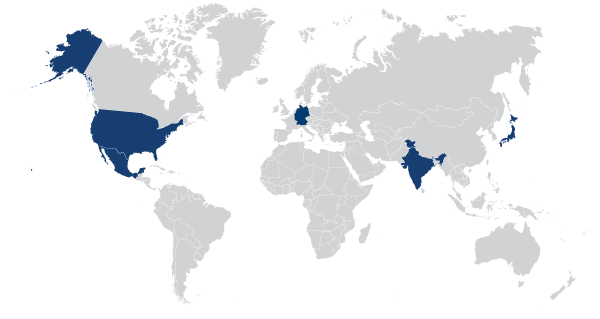
This is where HLS-Global UAE plays a pivotal role. With deep experience in regulatory strategy, company formation, and multilingual support, HLS-Global UAE helps clients navigate complex UAE market entry scenarios. From legal structuring and Tax registration to intercompany agreements and compliance filings, HLS – Global provides full-spectrum assistance. Our specialists offer tailored guidance for Japanese and other cross-border investors with precision and discretion.

Summary Table: Key Regulatory Triggers for UAE Market Entry Final Thoughts

Area

Requirement

Authority

VAT

Mandatory registration ≥ AED 375,000

FTA

Corporate Tax

Mandatory registration within 90 days from incorporation

FTA

UBO Disclosure

Mandatory for all legal entities

Ministry of Economy

Labour & Visa

Quotas, PRO services, MoHRE filings

MoHRE

Sectoral Licensing

Depending on business type

DED / Free Zones / Regulators

Conclusion

In the UAE, reputation and compliance are assets as valuable as capital. Regulatory oversights—whether in tax, licensing, or labor—can stall or jeopardize an otherwise promising venture. Investors must approach doing business in the UAE with a robust compliance-first strategy. HLS-Global UAE provides the insights and execution support needed to turn market entry into market leadership—smoothly, swiftly, and strategically. Speak to our experts for step-by-step guidance on Dubai market entry tailored to your business model.

Ready to expand into the UAE? Connect with HLS-Global UAE today for personalized and compliant UAE market entry solutions that align with your global business goals.

Connect with us on Linkedin.

Disclaimer:_ All views expressed in this article are solely for informational purposes and should not be construed as legal advice. This information is for reference only and is bound to change in case of any amendments or changes to applicable laws. We do not assume any responsibility or liability for any errors or omissions in the content of this article, and we do not make any warranties about the completeness, reliability, or accuracy of the information expressed in this article._

UAE family businesses, family business advisory

Reputation Risk in UAE Family Businesses: The Governance Blind Spot No One Talks About

Introduction

Family businesses contribute around 60% of the UAE’s GDP and are integral to its private sector. Yet, many legacy-driven enterprises face an underestimated threat: reputation risk, not just from public perception, but from legal, tax, and compliance blind spots.

With new mandates like the 9% Corporate Tax, Economic Substance Regulations (ESR), and AML/CFT compliance, any lapse for UAE family businesses can lead to financial penalties and loss of trust. Institutional investors and global partners now demand governance-aligned, ESG-conscious practices, which informal, founder-led models often fail to deliver.

At HLS-Global UAE, we emphasize governance-first advisory. Our services help family businesses build resilient structures that protect both legacy and reputation.

What is Reputation Risk in Family Businesses?

Reputation risk in family enterprises arises from internal disputes, poor governance, or regulatory non-compliance. Unlike public firms, many family-run companies rely on undocumented processes, increasing their vulnerability.

Recent UAE examples include:

  • A shareholder dispute in a second-gen trading group resulted in financial fallout.
  • A luxury retailer’s leaked audit conflict damaged public trust.
  • FTA penalties for ESR non-compliance in a well-known firm, spotlighting systemic gaps.

These aren’t PR issues—they’re governance failures. Under UAE law, businesses must align with Ministry of Economy mandates on compliance, succession, and transparency.

Why Traditional Governance Structures Fall Short?

Many UAE family businesses still operate under centralized, founder-led models, without formal boards or succession plans. This creates serious vulnerabilities, especially under growing regulatory scrutiny.

Common blind spots include:

  • No formal conflict resolution mechanisms.
  • Unregulated related-party transactions.
  • Non-compliance with new tax laws and ESR.

HLS-Global UAE addresses these through:

  • Shareholder agreements and family charters.
  • Succession planning and independent board setup.
  • Regulatory filings and dispute prevention protocols.

Key Governance Solutions to Safeguard Reputation

Challenge

Governance Solution

Informal decision-making

Family Charter & Shareholder Agreements

Succession disputes

Generational Planning & Board Advisory

Compliance breaches

Tax Structuring & ESR Audit Mechanisms

Brand dilution

IP Protection & PR Risk Audits

Regulatory Triggers for Reputational Damage

In the UAE’s compliance-driven ecosystem, reputation can be damaged by:

  • Corporate Tax & VAT non-compliance: Misreporting can trigger audits and fines.
  • Ownership disputes: Lack of succession clarity invites litigation and public fallout.
  • ESR & CbCR violations: Can result in fines up to AED 400,000 and affect cross-border operations.
  • Opaque structures: Raise red flags with banks and global partners.

How HLS-Global UAE Helps?

Our family business advisory ensures legacy protection through:

1. Governance Frameworks – Family constitutions, board charters, conflict protocols
2. Legal StructuringSuccession planning and inheritance law compliance
3. Tax Advisory – Transfer pricing, ESR, CbCR, and VAT risk mitigation
4.  Dispute Resolution – Confidential mediation and arbitration clauses
5.  Bilingual Support – Advisory in Japanese or Indian languages
6. Regulatory Liaison – Coordination with FTA,the  Ministry of Economy, and banks

Conclusion

Legacy can’t be protected by tradition alone. It requires modern governance, risk-aware planning, and compliance foresight. The Ministry of Economy and FTA have made one thing clear: transparency is non-negotiable.

Partner with HLS-Global UAE to build future-ready family business structures. Secure your reputation, your control, and your legacy—for generations to come.

Connect with us on Linkedin.

Disclaimer:_ All views expressed in this article are solely for informational purposes and should not be construed as legal advice. This information is for reference only and is bound to change in case of any amendments or changes to applicable laws. We do not assume any responsibility or liability for any errors or omissions in the content of this article, and do not make any warranties about the completeness, reliability and accuracy of the information expressed in this article._

Setting Up a Business in UAE: What You Need to Know Before You Start

Introduction: Why the UAE is a Hotspot for Global Entrepreneurs

As one of the fastest-growing global financial and trade hubs, the United Arab Emirates (UAE) has become a preferred destination for foreign investors and startups alike. Driven by the government’s Vision 2030 for economic diversification, the UAE has steadily moved away from oil dependency by fostering innovation, financial services, logistics, and advanced manufacturing. For entrepreneurs considering setting up a business, the UAE presents not just opportunity, but a resilient and regulated environment for sustainable growth.

The legal ecosystem is equally favorable. From the Federal Law No. 2 of 2015 on Commercial Companies (as amended) to the recent changes allowing 100% foreign ownership in mainland entities, the UAE has systematically eased entry barriers for global players. Investors can choose between mainland setups, which allow operation across the UAE without restrictions, and free zones, which offer sector-specific benefits like tax exemptions, 100% repatriation of capital and profits, and streamlined visa processes.

This investor-friendly climate is further bolstered by robust India–UAE relations. With the signing of the Comprehensive Economic Partnership Agreement (CEPA) in 2022, bilateral trade is projected to surpass USD 100 billion by 2030, opening new channels for Indian entrepreneurs entering the UAE market.

At HLS-Global UAE, we specialize in enabling smooth market entry by providing transaction advisory services, legal structuring, regulatory compliance, and tax planning tailored to both free zone and mainland company formations. Whether you’re an SME or a multinational, our cross-border expertise ensures that your business is structured right from day one.

If you’re considering setting up a business in the UAE, the right advisory partner is essential, especially in navigating licensing requirements, ownership laws, and sector-specific compliance.

Choose the Right Legal Structure

Choosing the correct legal structure is a foundational step when setting up a business in the UAE. The structure not only determines ownership rights, operational scope, and tax obligations but also defines your business’s regulatory and licensing pathway.

Mainland Company

A mainland company is licensed by the Department of Economic Development (DED) of the respective emirate and allows unrestricted access to the UAE market and government contracts. As per the Federal Decree Law No. 26 of 2020, most business activities (excluding a few strategic sectors) now permit 100% foreign ownership, eliminating the need for a local Emirati sponsor in many cases. Businesses can operate anywhere within the UAE and are allowed to trade directly with the local market.

Free Zone Company

Free zones are specialized jurisdictions offering incentives such as 0% corporate tax, 100% repatriation of capital and profits, and exemption from import/export duties. While trading within the UAE mainland requires the appointment of a local distributor, free zone companies are ideal for international trade, tech, logistics, and consulting services. Each free zone operates under its own authority but is subject to oversight from the UAE Ministry of Economy and sector-specific regulators.

Offshore Company

Offshore entities—typically set up in JAFZA, RAK ICC, or Ajman Offshore—are primarily used for holding structures, asset protection, and international tax planning. They cannot operate within the UAE or issue residence visas, but offer benefits such as confidentiality and zero taxation, provided there is compliance with Economic Substance Requirements and Anti-Money Laundering (AML)

Legal Reference: According to the UAE Ministry of Economy and DED Dubai guidelines, selecting the wrong structure can lead to regulatory non-compliance, fines, or even license revocation. Therefore, it’s crucial to align your business goals with the right formation model from the outset.

At HLS-Global UAE, we assist clients in evaluating these structures through a legal and financial lens, ensuring your business setup in the UAE is both compliant and strategically aligned. From licensing support to corporate structuring and ongoing compliance, our advisory team simplifies the journey for foreign investors and businesses entering the UAE landscape.

Regulatory Requirements to Comply With

When setting up a business in the UAE, understanding and complying with the country’s multi-layered regulatory framework is critical. The UAE government has streamlined the incorporation process in recent years, yet legal precision and adherence to regulatory expectations remain essential to avoid fines, delays, or business disruptions.

Trade License Categories

Every business must obtain a valid trade license, issued either by the Department of Economic Development (DED) for mainland businesses or by the respective Free Zone Authority for companies within a designated free zone. There are three main categories:

  • Professional License: For service-based businesses (e.g., consultants, legal, medical, or IT services).
  • Commercial License: For trading activities, including import/export, e-commerce, and retail operations.
  • Industrial License: For manufacturing, production, or industrial assembly processes.

Each license comes with its own compliance obligations, including activity-specific approvals from regulatory departments such as the Ministry of Health, Telecommunication and Digital Government Regulatory Authority (TDRA), or Civil Defense, depending on your business sector.

Visa and Immigration Procedures

A valid trade license also enables companies to apply for establishment cards and residency visas for shareholders, employees, and dependents. The number of visas permitted often depends on the size of the office space rented and the business activity. Free zone companies typically enjoy streamlined visa processes through one-stop-shop immigration desks.

Key requirements include:

  • Emirates ID application
  • Medical fitness test
  • Biometric registration
  • Entry permits (for non-residents)
Need for UAE National Sponsors (if applicable)

While most sectors now allow 100% foreign ownership, certain strategic or restricted activities—especially in defense, oil & gas, telecom, and utilities—still require a UAE national as a service agent or shareholder. In such cases, formal agreements must be drafted to protect the foreign investor’s commercial interests and outline roles, rights, and responsibilities.

 Legal Note: According to DED Dubai and several Free Zone Authority guidelines, failure to match your trade license and visa applications with your actual business activity can result in penalties or cancellation of licenses. Companies are also required to renew licenses annually and ensure that all immigration records are up to date.

At HLS-Global UAE, we offer specialized advice to help foreign investors seamlessly navigate the regulatory terrain of setting up a business in the UAE. From initial trade license selection to drafting local sponsorship agreements and managing visa applications, we ensure our clients stay legally compliant from day one.

Key Financial and Tax Considerations

As the UAE continues its evolution into a transparent and regulated global financial hub, businesses must take proactive steps to align with the country’s maturing tax framework. Understanding the financial obligations associated with setting up a business in the UAE is no longer optional—it is a legal necessity.

Corporate Tax Implementation – 9% from June 2023

Effective June 1, 2023, the UAE introduced a 9% corporate tax on taxable profits exceeding AED 375,000. This marks a significant policy shift, especially for foreign companies accustomed to the UAE’s historically tax-free status.

  • Applicability: Applies to all business entities operating in the UAE (including free zone entities if they earn income outside the free zone or do not meet qualifying criteria).
  • Exemptions: Free zone entities may continue to enjoy tax holidays if they meet specific qualifying conditions under the UAE Corporate Tax Law.
  • Reference: UAE Ministry of Finance – Corporate Tax Law Guidelines

Legal Insight: Businesses must register for corporate tax with the Federal Tax Authority (FTA), maintain audited financials, and submit annual tax returns. Non-compliance can lead to heavy penalties under Cabinet Decision No. 75 of 2023.

Value Added Tax (VAT) – 5%

Introduced in 2018, VAT in the UAE remains at 5%. Registration is mandatory if:

  • Your taxable turnover exceeds AED 375,000 annually (mandatory threshold).
  • For startups and SMEs below the threshold, voluntary VAT registration is allowed at AED 187,500.

 FTA Compliance Note: Filing of VAT returns is required quarterly or monthly, depending on your license. Late filings or inaccurate disclosures may attract fines under Federal Decree Law No. 8 of 2017.

Transfer Pricing Regulations

With the implementation of corporate tax, Transfer Pricing (TP) rules and documentation have become binding on UAE-based entities, especially those engaged in related-party transactions or international dealings. Businesses must comply with OECD-aligned TP standards, maintain master and local files, and disclose related-party transactions in corporate tax returns.

At HLS-Global UAE, our tax and regulatory experts help international investors navigate the evolving tax landscape while setting up a business in the UAE. From tax structuring, VAT registration, and TP documentation to corporate tax readiness, we ensure full-spectrum support tailored to your sector and structure.

Banking, Capital, and Operational Readiness

When setting up a business in the UAE, ensuring operational readiness goes beyond company registration—it extends to establishing your banking footprint, complying with capital norms, and securing the right commercial premises. Each of these elements carries specific regulatory implications that foreign investors must plan for strategically.

Opening a UAE Corporate Bank Account: What You Need to Prepare

Opening a business bank account in the UAE is often one of the most time-sensitive steps post-incorporation. Due to enhanced KYC (Know Your Customer) and AML (Anti-Money Laundering) protocols, banks follow strict due diligence procedures, especially for foreign-owned businesses.

Typical documentation required includes:

  • Valid trade license (issued by DED or Free Zone Authority)
  • Shareholder and director passports, Emirates IDs (if applicable)
  • Memorandum of Association and Certificate of Incorporation
  • Office lease agreement (Ejari for mainland or Flexi-desk contract in free zones)
  • Corporate structure chart and source of funds disclosure

Regulatory Insight: Banks like Emirates NBD, ADCB, and Mashreq may also request the Ultimate Beneficial Owner (UBO) declaration under UAE Cabinet Resolution No. 58 of 2020.

Minimum Capital Requirements: Jurisdiction Matters

Unlike earlier mandates, most UAE jurisdictions no longer require a minimum paid-up capital, especially for Free Zone Companies (FZCs) and Limited Liability Companies (LLCs). However, certain Free Zones (like DMCC or ADGM) still require disclosure of intended capital, particularly in regulated sectors like fintech or commodities trading.

Office Space Rules: Mainland vs. Free Zone
  • Mainland (DED): A physical office lease is mandatory and must be registered via the Ejari system. Shared or co-working spaces are generally not accepted.
  • Free Zones: Offer flexibility with Flexi-desk, shared workspace, or dedicated office. This is ideal for startups or businesses testing the market waters.
  • Virtual offices: Not accepted in most licensing jurisdictions for regulated activities.

Step-by-Step Process of Setting Up a Business

Whether you’re entering through a Free Zone or the Mainland, here’s a simplified overview of the key steps involved in setting up a business in the UAE:

Table: Business Setup Roadmap in UAE

Activity

Responsible Authority

Choose jurisdiction & legal structure

Free Zone / DED / Offshore Reg

Reserve trade name & draft MOA

Department of Economic Development (DED)

Obtain initial approvals

DED / Free Zone Authority

Apply for a trade license

DED / Free Zone Authority

Open a corporate bank account

Local/UAE Bank

Register for tax (VAT / CT if applicable)

Federal Tax Authority (FTA)

Secure office space & visas

GDRFA, Municipality


HLS-Global’s Role in Your UAE Market Entry

In the evolving and competitive UAE business landscape, foreign investors need more than just a registration certificate. They require a structured entry plan, backed by legal insight, tax clarity, and cultural fluency. This is where HLS-Global UAE becomes a strategic partner in your journey of setting up a business in the UAE.

Entity Setup, Legal Structuring, and Documentation

At HLS-Global UAE, we handle the complete lifecycle of business formation—from initial feasibility analysis to incorporation of the right legal entity (Mainland, Free Zone, or Offshore). Our team ensures that:

  • MOA/AOA and shareholder agreements align with the UAE Commercial Companies Law (Federal Law No. 32 of 2021)
  • The company structure supports 100% foreign ownership, where permitted under the UAE FDI Law (Decree Law No. 19 of 2018)
  • All incorporation documents are accurately prepared and notarized for submission to the Department of Economic Development (DED) or the respective Free Zone Authority
Regulatory Liaison and Compliance Filing

Navigating regulatory approvals—whether from the Ministry of Economy, Chambers of Commerce, Immigration Authority, or UAE Central Bank—requires ongoing liaison and legal understanding. HLS-Global provides:

  • License classification and trade name approvals
  • VAT registration and UBO filings
  • Periodic compliance monitoring and renewal services
Tax Planning and Ongoing Advisory

With the introduction of UAE Corporate Tax (9% effective from June 2023) and Transfer Pricing guidelines, startups and SMEs must align their tax position with operational realities. HLS-Global UAE supports clients with:

  • Tax-efficient structuring of revenue streams and shareholder payouts
  • Transfer pricing documentation under OECD standards
  • Filing of Corporate Tax registration with the Federal Tax Authority (FTA)
Japanese Language and Cross-Border Support

For Japanese entrepreneurs, cultural and linguistic nuances can be barriers to market entry. HLS-Global UAE offers:

  • Bilingual support in Japanese and English
  • Seamless cross-border coordination with legal, accounting, and banking partners in Japan and the UAE
  • Advisory on repatriation of profits

At HLS-Global UAE, our commitment goes beyond just setting up a business—we help you build a legally robust, tax-compliant, and future-ready UAE presence. Whether you’re launching a tech startup in DIFC or expanding a family business into the Dubai mainland, our cross-border advisory ensures you do it right the first time.

Final Thoughts: Start Smart with Strategic Guidance

In the UAE’s highly regulated and opportunity-rich environment, setting up a business without proper legal foresight can prove costly. From delayed license approvals and invalid corporate documents to heavy penalties for non-compliance with VAT, AML, or Corporate Tax laws, the risks of an ad-hoc setup far outweigh the short-term cost savings.

As per the UAE Commercial Companies Law, any deviation from the approved company structure or failure to submit timely filings (such as Ultimate Beneficial Owner (UBO) declarations) may invite regulatory action, fines, or even suspension of operations. Similarly, incorrect classification of your business activity during trade license issuance can require re-registration or amendments, impacting timelines and operations.

This is where proactive legal and transaction advisory play a decisive role.

By partnering early with seasoned consultants like HLS-Global UAE, entrepreneurs gain:

  • Tailored entity structuring aligned with UAE laws and your operational model
  • Clarity on ownership rights, FDI permissions, and profit repatriation pathways
  • Confidence that every legal and financial checkbox is ticked from Day 1

***

Disclaimer: All views expressed in this article are solely for informational purposes and should not be construed as legal advice. This information is for reference only and is bound to change in case of any amendments or changes to applicable laws. We do not assume any responsibility or liability for any errors or omissions in the content of this article, and we do not make any warranties about the completeness, reliability, or accuracy of the information expressed in this article.